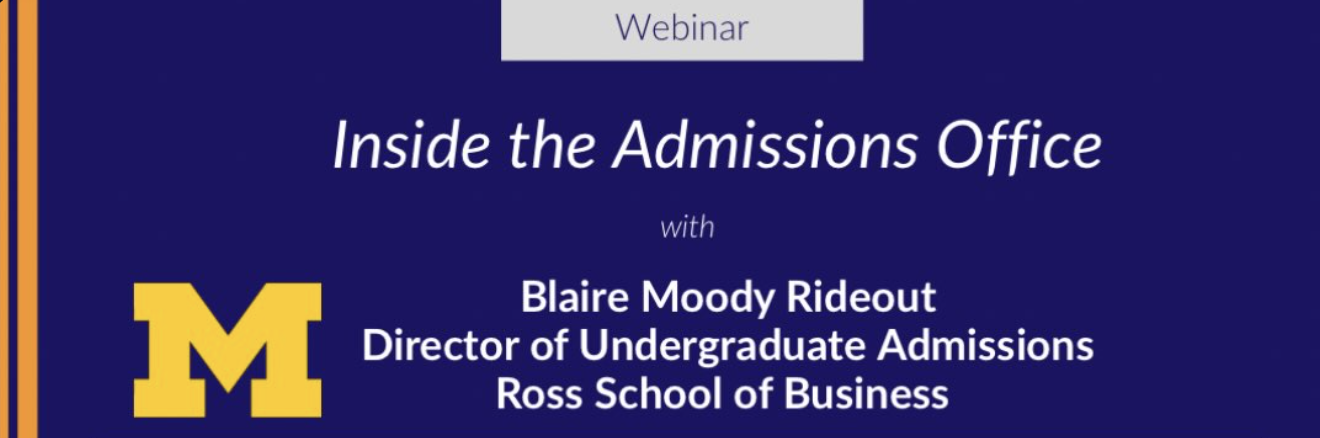
Expert Admissions hosted a webinar with Blaire Moody Rideout, Director of Admissions at the University of Michigan’s Ross School of Business. We discussed who should apply to the Ross BBA, Early Decision vs. Early Action, how Ross reviews applications, the Ross portfolio, and more.
Who Should Apply to the Ross BBA?
Blaire began by offering some overall thoughts on how an undergraduate business program like Ross differs from a liberal arts degree.
When thinking about the Ross BBA versus studying economics in Michigan’s College of Literature, Science, and the Arts (LSA), for instance, think about what kind of a curriculum you want. Economics is theoretical and policy-focused, while the BBA is a professional degree that teaches practical skills like accounting and financial modeling. And because the BBA is modeled after the MBA curriculum, most Ross graduates don’t need to pursue an MBA later.
The BBA is a broad-based management degree with no majors. Instead, students choose areas of specialization, from finance, accounting, marketing, and consulting, to niche options like sustainability, supply chain, and a new specialization in artificial intelligence.
Applicants don’t need to know their specialization yet. Students explore the options in the first-year seminar, BA 100, and usually choose one by the end of sophomore year. When applying, it’s enough to be excited by case analysis, problem solving, and group work.
Ross follows Michigan’s single-choice admission model. If you aren’t admitted to Ross, you won’t be considered for LSA. Fewer than 100 students transfer into Ross each year, so if you know you want business, apply from high school. Students elsewhere at Michigan can still take Ross electives; join many Ross clubs; participate in business workshops, competitions, and leadership experiences; and pursue a business minor.
The Integrated Business and Engineering (IBE) Program is the one exception to the single-choice model: applicants can request additional consideration for Ross or Engineering. The IBE program lets students earn degrees in both business and engineering and is a good fit for students who do really well in science and math, since chemistry, calculus, and physics are required to apply.
Early Decision vs. Early Action
This is Michigan’s second year offering binding Early Decision. ED could be a great option if Michigan is your top choice and your academics fit the admitted student profile. ED applicants hear back in December. Early Action remains Michigan’s main admissions pathway and is a strong option if Michigan isn’t your first choice but you are still very competitive academically.
There’s no review advantage to submitting before the EA/ED deadline, but submitting by mid-October can give you peace of mind. Applicants who apply a week or more before the November 1 deadline generally get their portal login within a day or so and can confirm their materials arrived. Those who submit near the deadline may wait three to five days.
What Happens After You Click Submit?
Ross receives more than 13,000 applications for 560 spots each year. Even so, its admissions readers spend about half an hour on each one. Two Ross readers independently review the Common App essay and Michigan essays, activities list, and Ross portfolio, while Michigan’s central admissions office conducts an academic review by territory. A management team then makes decisions, which Blaire and the associate dean certify.
Because Ross is committed to a holistic review of each student, they do not use AI in the application process, either to review applications or to detect AI use. Michigan’s policy is also that students may not use AI to generate content. Ross readers are looking for reflective writing that helps them learn about the student, and AI strips out exactly that kind of personal reflection.
High-School Preparation
Ross focuses on applicants’ core academics, including math (calculus if your school offers it), English, world languages, social sciences, and natural sciences. Ross isn’t looking for you to take business classes, like AP Business and Personal Finance, which they don’t count as a core academic. Ross will teach you business, so they encourage taking an additional quantitative or otherwise challenging core academic course over AP Business.
Michigan (including Ross) is truly test-optional, though your curriculum carries even more weight if you do not submit scores. If your scores fall within Michigan’s admitted student range, submitting may be appropriate, but talk it through with your school counselor.
Outside the classroom, you don’t need to start a business or be part of a business club. Ross loves part-time jobs like lifeguarding, retail, or fast food service, which often teach students more than a passive internship. Leadership matters, too. One successful graduate’s high-school activities were all in theater, where she handled the organizational side: securing the space, selling ads, and fundraising. Do what you love, and lead within it.
The Ross Portfolio
The Ross portfolio has two parts:
The Business Case Discussion mirrors the case analyses students conduct in Ross classes. You are asked to identify an issue in your own community, which you should state in your first sentence, then look at it from multiple perspectives and propose a hypothetical solution. Ross isn’t judging whether your solution would work, but how you think. Stay away from business jargon or broad societal issues that require research. The best issues to address also tell the reader a little more about the student’s interests or where they’re from, like falling yearbook sales or local farms being replaced by data centers.
The Artifact is evidence of your learning and growth. Blaire suggests asking teachers, friends, or family when they see you at your best, or asking yourself what you’re most proud of. The reflection matters more than the object. One student’s artifact was a screenshot of a difficult Google review she responded to at her coffee shop job, and her reflection showed real growth.
To close, we asked Blaire what artifact she would submit. After 14 years in her current role and 20 at Michigan, she said would choose her 20-year milestone pin and reflect on all she has learned along the way.
For all the details on these topics and more, watch the webinar above.
Leave a Reply